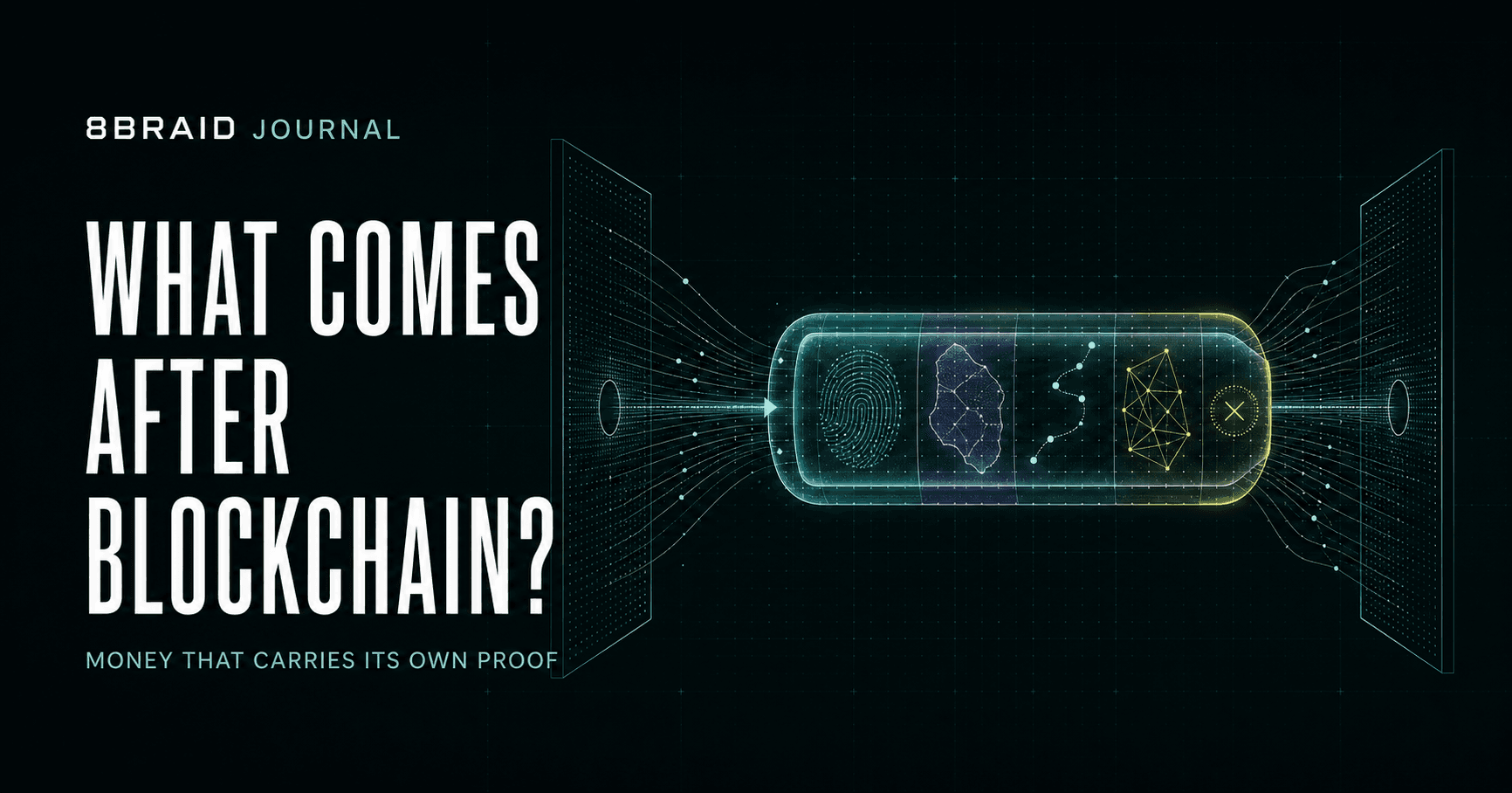
Blockchain made a shared transaction history believable. 8DB points toward a different future: transactions that carry their authority, policy, provenance and supporting proof, with protection and disclosure defined for each operation.
Scope update, 14 September 2026: The purchase below is a future scenario. It combines implemented mechanisms with proposed network and privacy outcomes. Integrity proofs, controlled disclosure and zero knowledge are distinct; our proofs guide explains what each check establishes.
At 9:14 on a February morning in 2032, a factory in Calgary realizes it is about to break a promise.
One of its oldest milling machines has begun to drift. The change is almost imperceptible: a faint vibration pattern, a little more power consumed on each cycle, a few microns of error appearing in finished parts. But the factory has promised a medical-device customer that 4,800 precision housings will leave the building by Friday. If the mill fails, ten people lose a week of work, the customer misses a production window, and a small company absorbs a penalty it cannot comfortably afford.
The owner does not see the alert. He is driving his son to school.
The factory’s local AI does. It compares the vibration signal with years of maintenance history, the geometry of the affected parts, open orders, available cash, shipping routes and the contractual tolerances promised to the customer. It concludes that waiting is more expensive than replacing the machine.
By 9:14:01, it has found a certified used mill in Osaka.
What happens next is the part today’s financial infrastructure cannot do cleanly.
The AI verifies that the machine exists, that the seller owns it, that its title is unencumbered, that its inspection certificate came from an authorized issuer, and that the buyer may legally import it. It negotiates a price. It assembles financing against invoices the seller is not allowed to see. It proves that the purchase agent is acting within a human-approved budget and purpose. It checks that the transaction satisfies the policies of the buyer, lender, insurer, seller and two jurisdictions.
Then the factory buys the machine.
No global audience watches its finances move across a public ledger. No bridge creates a wrapped representation and asks everyone to trust that the original asset is still there. No compliance team waits for a nightly batch process to discover that a payment should not have settled. No participant receives more private information than it needs.
The payment carries more than value. It carries proof of who may use it, what it represents, which policy authorized it, which evidence supported that decision, and whether the same entitlement has already been spent.
At 9:30, the owner receives an explanation, a shipping plan and a request to approve the final delivery window. He never chooses a blockchain, copies a wallet address, studies a gas fee or signs a hexadecimal message he cannot understand.
To him, this does not feel like crypto.
That may be what comes after blockchain.
The argument in one minute
Blockchain solved a profound problem: how strangers can agree on a transaction history without asking one trusted institution to maintain it.
But a believable history is not the same thing as a believable transaction.
A real transaction depends on identity, authority, privacy, policy, provenance, legal rights, external evidence, recovery and the meaning of the asset itself. Most blockchain systems keep only a thin representation on-chain and rebuild the surrounding truth through wallets, custodians, identity providers, oracles, bridges, indexers, rollups, compliance systems, cloud databases and off-chain storage.
8DB proposes a different center of gravity.
Instead of treating the ledger as the trust layer and data as something stored around it, 8DB makes the protected data substrate the trust layer. The same underlying information can carry encryption, identity, provenance, policy, authorization, causal history and proof. A transaction becomes a governed projection of that protected state.
A believable sequence is the starting point. The next step is making a transaction's authority and evidence inspectable.
That does not eliminate consensus, institutions or law. It can reduce the number of seams where those systems disagree, leak information or silently trust something they cannot prove.
Blockchain made history trustworthy, not the world around it
The original cryptocurrency proposition was radical and precise. Bitcoin described peer-to-peer electronic cash that could prevent double spending without a trusted financial institution, using a network to agree on an ordered history. (Bitcoin whitepaper)
It worked.
Bitcoin demonstrated that a permissionless network could maintain a scarce digital asset without a central issuer. Ethereum extended the model into programmable contracts, tokens and composable financial applications. The result was not merely a new asset class. It was a new way for strangers to believe the same sequence of events.
Then the industry tried to fit more of the world into that sequence.
That is where the architecture begins to strain. A scarce bearer asset needs an agreed order because it cannot have two valid owners at once. But a medical credential does not need to be broadcast so a pharmacy can verify one attribute. A supplier’s private contract does not need universal replication so a lender can verify that an invoice exceeds a threshold. A machine’s complete 3D inspection scan does not need to live on a chain so a buyer can prove that a certified defect test passed.
Two independent events do not need a global order merely because both occurred inside a financial system.
Yet much of crypto’s surrounding infrastructure exists because a ledger cannot natively represent the full transaction:
- Identity lives in wallets, exchanges and credential services.
- Real-world facts arrive through oracles.
- Private documents and large data live off-chain.
- Search depends on indexers and replicated analytical stores.
- Privacy arrives through separate proof systems, shielded pools or special protocols.
- Scale moves execution to rollups, sidechains and Layer 2 systems.
- Assets cross domains through bridges.
- Compliance is evaluated by screening and case-management products.
- Recovery lives with custodians, social graphs or exceptional contracts.
- Legal meaning remains in agreements, registries and courts.
Each component may be well designed. Together they create a paradox: the system built to remove trusted intermediaries can become a polyglot stack of new intermediaries, privileged keys, duplicated state and cross-system assumptions.
Ethereum’s own documentation explains parts of this evolution plainly. Rollups execute and maintain state away from the base layer while publishing data, summaries or proofs back to it. ZK rollups are not automatically private. Bridges introduce smart-contract, systemic and counterparty risks. (Ethereum scaling, ZK rollups, privacy, bridges)
This is not an argument that blockchain failed. It is an argument that blockchain brilliantly solved one part of a larger problem.
The original promise was not “put everything in a chain.”
It was “let people and machines coordinate value without blind trust.”
8DB moves trust into the data itself
Most databases treat security as a perimeter.
Data is modeled first. Encryption, authorization, audit, replication, search, policy, recovery and proof are then supplied by different layers around it. A conventional high-security transaction may cross an application server, policy engine, identity provider, key manager, screening service, encrypted database, search index, event bus, audit warehouse and recovery system.
Every handoff is a place where meaning can drift.
A policy cache can be stale. An identity can resolve differently in two services. An index can reveal what its encrypted source conceals. A service account can bypass the application path. A bridge can attest to the wrong representation of an asset. An administrator can approve a write without preserving which policy version or evidence set produced the decision.
8DB begins with a different primitive: one protected information object can carry the properties the surrounding stack usually reconstructs.
Its identity can remain stable while cryptographic algorithms and keys rotate. Its provenance can explain where it came from. Its causal history can show which state depended on which earlier state. Its policy can determine who may perform which operation, for which purpose, in which region and epoch. Its confidence and knowledge state can record what is known, uncertain, stale, conflicted or deliberately withheld. Its proofs can let another party verify a defined claim without receiving the entire object.
Most importantly, policy can participate in the key derivation and state transition itself.
Policy-derived keys bind protected transitions to the configured identity, scope, purpose, region, policy epoch and evidence context. The application must validate that context and control access to root key material. The resulting audit evidence can preserve the policy fingerprint and decision context used at write time.
This does not make bad policy impossible. It makes the assumptions explicit and makes bypassing the intended enforcement path materially harder.
In the Calgary transaction, compliance is not a report written about the payment after it happens.
The permissible payment and the protected write are the same operation.
Real-world assets stop being links to off-chain truth
Most tokens are deliberately thin. They represent a quantity, an owner and transition rules. Everything that gives the token meaning, a legal claim, physical object, reserve, identity, jurisdiction or regulatory status, usually lives somewhere else.
That is manageable for an asset born inside a chain. It is harder when a token claims to represent a machine, building, shipment, patent, energy credit, insured risk or bank deposit.
Consider the milling machine.
One system stores title. Another stores maintenance history. Another holds its inspection certificate. A time-series database contains sensor readings. An object store contains images and manuals. A spatial system contains the 3D scan. A graph represents its components and ownership chain. A vector index allows similarity search. A lender stores the lien. An insurer stores the policy. A logistics provider stores location. An AI creates learned representations of failure risk.
A blockchain can point to these records. It cannot make them the same fact.
8DB treats modality as projection. Shared typed atoms can be viewed as documents, tables, key-value records, graphs, hypergraphs, vectors, time series, spatial objects, point clouds, tensors, order lattices, geometric manifolds or transaction topologies without copying the subject into a succession of modality-specific databases.
The machine’s serial number, legal title, sensor history, 3D geometry, component topology, service documents, learned embedding, insurance state and financial claim can remain different views of one protected identity.
This matters to a buyer for reasons that have little to do with database elegance.
Fewer ETL pipelines means fewer copies of sensitive information. Fewer copies mean fewer credentials that can retrieve them, fewer synchronization jobs that can drift, fewer schemas that can disagree and fewer security policies that must remain perfectly aligned. The attack surface of a polyglot architecture is not merely the sum of its databases; it includes every connector, service account, queue, export, cache and recovery process between them.
A single substrate does not automatically become secure because it is singular. Its advantage depends on strong isolation, scoped keys, policy boundaries, recovery and observability inside the substrate.
With those controls, the financial proof becomes more meaningful.
A lender could verify that the machine satisfies a geometric tolerance, has an unbroken maintenance lineage, remains insured in the correct jurisdiction and is not already pledged, without receiving the complete point cloud, maintenance log, insurance contract or customer books.
The token stops being a detached symbol pointing toward the world.
It becomes a governed view of protected reality.
Privacy becomes a property of the transaction
“Zero knowledge” has become one of crypto’s most elastic phrases. It is often used for any system in which someone sees less information, even when the mechanism is encryption, trusted hardware, redaction or a designated-verifier attestation.
A credible private financial system needs sharper boundaries.
8DB’s privacy architecture works in layers.
Post-quantum-rooted encryption protects data at rest and in transit. Scoped keys limit what an individual derived key can open; root-key isolation and recovery remain part of the deployment design. Metadata and existence controls reduce what unauthorized observers learn from the shape of the system. Sealed indexes support protected search without leaving a plaintext side index that undoes the security of the underlying records. Policy can restrict access by identity, purpose, region, epoch and operation.
Those are privacy mechanisms. They are not automatically zero-knowledge proofs.
8DB includes proof mechanisms for defined computations, authenticated membership and policy evidence. A transparent proof of computation does not automatically hide its inputs. Credential eligibility without revealing the underlying record is a further protocol goal: it needs a specified private witness, a verifier that protects it, and evidence about the complete transcript. The current integrity mechanisms alone do not establish that privacy guarantee or unlinkable credential use. See the proofs guide for the implementation boundaries.
The distinction is easier to understand as a transaction:
- Encryption hides the private data.
- Policy determines which operation may obtain authority to act.
- An attestation binds a decision to a verifier and policy context.
- A zero-knowledge proof demonstrates that a defined statement is true without revealing the defined witness.
- A nullifier checked against current spent state can help reject repeated use. Its privacy and linkability depend on the credential protocol and what else is disclosed.
In the imagined purchase, the goal is for the buyer to demonstrate eligibility, a human-approved purchasing mandate and an unspent financing entitlement while withholding unrelated records. Delivering that goal requires authenticated inputs, current revocation and spent state, and a separately validated disclosure protocol. The seller should not need the owner's passport or the factory's payroll file merely to check those predicates.
Even a valid zero-knowledge proof would not make every transaction unlinkable; timing, counterparties, amounts, issuer knowledge and network behavior need their own protections.
The design goal is controlled disclosure, with zero knowledge only where a specific protocol establishes it.
For an institutional buyer, that difference is the line between a slogan and a security model.
Post-quantum protection does not have to bloat every record
Finance has an unusually long cryptographic memory.
Identity and ownership records remain sensitive for decades. A signature produced today may need to be trusted years from now. An attacker can collect encrypted traffic now and wait for better hardware. A long-lived ledger cannot casually forget the keys and signatures that define its history.
NIST has standardized ML-KEM for post-quantum key establishment and ML-DSA for post-quantum signatures. (NIST FIPS 203, NIST FIPS 204)
For an existing cryptocurrency or financial system, adopting new algorithms is not simply a cipher-suite upgrade. Wallet identities, account authorization, historical signatures, transport protocols, hardware assumptions, recovery procedures, light clients and operational tooling all have to migrate without creating a downgrade path or splitting the network.
8DB places cryptographic agility beneath the application model. A hybrid ML-KEM-1024 plus X25519 exchange can establish protected keys, while ML-DSA-87 provides high-assurance post-quantum signatures. Cryptographic algorithms, key epochs and re-encryption can evolve without changing the durable identity of the protected information above them.
The storage result is counterintuitive.
In a controlled comparison,1 classical and post-quantum-rooted records used the same AES-256-GCM-SIV payload encryption. A tested 115-byte plaintext record occupied 131 bytes in both encrypted paths. Classical and PQC-rooted reads and writes both measured at roughly 31 microseconds, with no meaningful per-record difference. The post-quantum cost was a one-time 1,616-byte key-establishment envelope, amortizing to 0.0123 percent across 100,000 records.
The measurement isolates a specific mechanism. Its important commercial implication is precise: post-quantum key establishment does not have to create additional per-record bloat or per-record latency when it establishes the key boundary instead of wrapping every record in a new public-key operation.
Search follows the same architectural principle. The encrypted index is sealed under the protected key rather than maintained as a plaintext side structure. In the measured path, opening and searching the sealed index took 19.0 milliseconds, compared with 36.4 milliseconds for decrypt-and-scan across 2,000 records. Once open, subsequent searches ran near the roughly 50-microsecond plaintext path.
This is protected native search.2
For a buyer, the larger implication is architectural: quantum migration can begin in the storage, identity and transport substrate without multiplying every application’s data footprint.
Consensus remains, but fewer operations may need it
The easiest claim to make about a post-blockchain architecture would also be the least credible: that consensus disappears.
It does not.
Independent parties still need agreement when one shared outcome must survive faults or adversaries. A bearer entitlement cannot be spent twice. Two validators cannot finalize conflicting owners. A reserve cannot have two simultaneous balances. A membership change cannot be accepted differently by honest participants that must continue operating together.
The useful question is not whether consensus exists.
It is how much of the world must pass through it.
Blockchains tend toward a total or near-total order because the chain is the common source of truth. 8DB can preserve causality directly: this payment depended on that credential, derived from this policy epoch, consumed this entitlement and updated this asset state.
Independent causal branches can remain independent until they touch the same constrained state.
A purchase in Calgary and a payroll event in Nairobi do not need a universal order. Two attempts to consume the same financing entitlement do.
In an 8DB-enabled financial network, local writes, private evidence, projections, searches and nonconflicting causal branches can proceed without asking every participant to reproduce them. A consensus protocol can be reserved for the smaller boundary where parties must agree: double-spend prevention, conflicting ownership, validator membership, checkpoint publication or cross-domain settlement.
This does not dissolve the blockchain trilemma or evade classical distributed-systems limits.
It changes the unit submitted to consensus.
If the unit is an entire replicated execution history, the coordination surface is large. If the unit is a compact conflict, commitment or finalized transition whose private evidence has already been verified, the surface may be much smaller.
That leads to the strategic question: how much global coordination are financial systems paying for because their data layer cannot preserve causality, policy and provenance on its own?
A trustworthy financial system can say “I don’t know”
Smart contracts prefer clean booleans. The world rarely supplies them.
Was the cargo delivered? The satellite location says yes. The dock sensor says no. The carrier’s feed is twelve minutes stale. The inspection certificate is valid, but its issuer has just rotated keys. The beneficial owner appears unchanged, but a registry update is pending.
A conventional data pipeline often converts this uncertainty into false certainty before a contract sees it. It chooses one source, substitutes a default or drops a missing field. By the time the value reaches the transaction, the ambiguity has vanished, and so has the evidence that it ever existed.
8DB can preserve confidence, provenance, freshness, typed absence and knowledge state as part of the information itself. A policy can distinguish false from unknown, not observed, withheld, stale, conflicted or not applicable. An epistemic mesh node can state not only what it believes, but why, from which causal frontier and with what confidence.
This creates a financial behavior that sounds almost human: abstention.
The system can decline to finalize a transaction when its evidence is insufficient without pretending that the transaction is forbidden. It can quarantine a stale oracle path, request another proof, route around a distrusted source, preserve the dispute or settle only the uncontested portion.
For autonomous agents, this may matter more than speed.
A financial AI that always produces an answer is dangerous. A financial AI that can prove the limits of its authority, expose its evidence and refuse to act when the knowledge state is inadequate is a new kind of participant.
The Calgary factory’s AI did not buy the cheapest machine because an opaque model said so. It operated inside a bounded purpose, budget, jurisdiction and evidence envelope. Its authority was consumable, auditable and revocable. The transaction was valid because the agent could prove that it held the right to perform that specific act, not because it possessed a reusable master key.
Bridges become explicit trust paths
Bridges reveal a fundamental crypto compromise.
A token moves between systems that do not share state. One domain locks or represents the asset; another accepts a claim about it. The bridge must verify messages, manage keys or validators, and preserve the relationship between the original asset and its representation.
When that relationship breaks, the wrapped asset can remain technically valid while becoming economically false.
An 8DB network would not remove the need to trust external domains. It could make the trust path explicit and computable.
A cross-domain transition can carry:
- The source commitment and causal frontier.
- The identity and authorization of the attesting party.
- The policy and cryptographic epoch under which it was produced.
- The freshness, confidence and provenance of external facts.
- A proof that the source transition satisfied its defined rules.
- A nullifier or consumption record preventing reuse.
- The destination policy that decides whether the evidence is sufficient.
Instead of asking only, “Did a quorum sign this message?” the destination can ask, “What does this quorum know, under which authority, about which version of the asset, based on which evidence, and has the claim already been consumed?”
A compromised source majority can still lie. A physical custodian can still lose an asset. A court can still reject a claim.
Provenance does not manufacture truth.
It stops trust from becoming invisible.
Integrity allows correction without silent rewriting
Crypto culture often treats immutability as a moral property. If history cannot be changed, the system must be honest.
Real institutions need a more complicated form of honesty.
Courts reverse transfers. Regulators revoke permissions. People lose keys. Fraud is discovered. Personal data may need to be erased. Consent changes. Algorithms are found defective. A transaction can be technically valid and legally void.
8DB’s provenance model can preserve reversible transformations, inverse records, tombstones, governance epochs and evidence of what changed. Encrypted data can be made inaccessible through scoped key destruction while a minimal commitment or audit fact remains. A correction can become a new linked state transition instead of a silent rewrite.
This is not the fantasy that every copy on every machine can be forced to vanish. It is a way to define which bytes, indexes, replicas, backups, derived artifacts and keys are destroyed, and which legal or cryptographic evidence remains. That distinction is increasingly important as regulators develop guidance for personal data on blockchains. (European Data Protection Board)
Integrity means that a system can explain its present state, prove the transformations that produced it, identify the authority under which they occurred and expose attempted rollback.
An isolated software node still needs an honest external monotonic reference, a hardware counter, published checkpoint or mesh witness, to detect a perfectly consistent rollback of its complete state. A decentralized mesh can provide that witness without requiring every private fact to become public forever.
The future of trustworthy finance may depend less on making mistakes impossible to correct than on making every correction explicit, authorized and provable.
When crypto disappears, the infrastructure has won
Return to the Calgary factory.
The owner never chooses a chain. The seller never wonders whether a wrapped asset is fully backed. The lender never receives the factory’s raw books. The regulator never receives a global surveillance feed.
Each participant sees a different governed projection of the same transaction:
- The buyer sees price, financing and delivery risk.
- The seller sees final settlement and proof of buyer eligibility.
- The lender sees the collateral and repayment conditions it may inspect.
- The insurer sees the machine and route risk covered by its policy.
- The regulator sees the required compliance evidence.
- The auditor sees the transition, policy version and provenance chain.
- The public, where public verification is necessary, sees a compact proof rather than the private commercial life behind it.
The transaction’s cryptography is everywhere and almost nowhere visible.
That may be the real end state of cryptocurrency: not a world in which every person becomes a part-time cryptographer, but one in which cryptographic assurance becomes an ordinary property of information.
The internet succeeded when people stopped talking about packets. Databases succeeded when applications stopped caring which disk block held a customer record. Post-quantum cryptography will succeed when users no longer need to know which key-establishment algorithm protected a transaction.
Programmable money may succeed when money stops being a thin token traveling through a maze of compensating systems and becomes a protected relationship among identity, authority, evidence, policy, state and time.
The architecture behind the vision
The future scenario combines implemented substrate mechanisms with application and network goals. The table distinguishes the current building blocks from outcomes that need further protocol and deployment evidence. Digital Fabric is our financial infrastructure implementation on 8DB; its claims matrix states its narrower operating scope.
| Buyer problem | 8DB substrate capability | Practical implication |
|---|---|---|
| Long-lived quantum exposure | Hybrid ML-KEM-1024 + X25519 key establishment; ML-DSA-87 signatures; algorithm and key epochs | Post-quantum migration becomes a substrate concern instead of an application-by-application rewrite |
| Encrypted storage overhead | Shared AES-256-GCM-SIV record encryption with an amortized PQC envelope | The controlled page-encryption test adds zero incremental PQC ciphertext bytes, with paired median encryption times within 0.55%; key establishment, signing and metadata have separate costs. See the measurements. |
| Private lookup | Sealed indexes and scoped key opening | Search need not rely on a plaintext side index; access-pattern leakage remains a separate threat-model question |
| Selective disclosure | Authorized views, attestations and defined proof mechanisms; hidden-witness privacy requires its own validated protocol | Share the evidence a verifier needs; do not infer zero knowledge from a signature, membership proof or computation proof |
| Transaction authorization | Policy-, purpose-, scope-, identity- and epoch-bound key derivation | Acceptable protected transitions can be cryptographically bound to current authority and policy |
| One-time rights | Entitlement records and durable spent-state tracking | Check repeated use against current state; offline double-use resistance, rollback behavior and unlinkability require explicit protocol assumptions |
| Policy checks and audit | Policy-bound evidence receipts, designated-verifier attestations and proof-carrying transitions | Put configured checks in the write path and preserve decision evidence; source accuracy and legal sufficiency remain separate questions |
| Real-world assets | Provenance-native multimodal atom identity | Legal, spatial, sensor, document, graph, vector and financial views can refer to one protected subject |
| Oracle quality | Freshness, confidence, source provenance, typed absence and abstention | The system can preserve uncertainty instead of flattening it into a dangerous boolean |
| Cross-domain exchange | Proposed composition of proof-carrying state, causal frontiers, source identity and policy epochs | Make bridge assumptions explicit; cross-domain finality and privacy remain network-level obligations |
| Network coordination | Causal ordering with consensus at conflict boundaries | Independent operations can remain local; double spends and conflicting ownership still require agreement |
| Autonomous agents | Bounded, consumable authorization with explainable evidence | Agents can act within provable mandates and refuse when evidence is inadequate |
| Audit and recovery | Content addressing, causal proof chains, scoped recovery and anti-rollback witnesses | Present state can be reconstructed and explained without treating one append-only log as the whole truth |
| Correction and erasure | Reversible transformations, tombstones and scoped cryptographic erasure | Legal correction and lifecycle privacy can coexist with evidence that a governed change occurred |
| Infrastructure sprawl | Embeddable engine, native mesh and modality-as-projection | Fewer databases, ETL routes, service accounts, duplicated indexes and independent security policies |
The next proof is operational
The substrate mechanisms create the possibility. The next step is to prove the network around them under real conditions.
That means defining the validator set and fault model; measuring geographically distributed throughput and finality; specifying proof statements, witnesses and leakage; testing policy authority and evidence freshness; and showing how wallets, recovery, governance and institutional migration work together.
It also means independent cryptographic review, adversarial testing, formal protocol specifications and reproducible release-mode benchmarks.
These are not reasons to wait before rethinking the architecture. They are the roadmap from a protected data substrate to dependable financial infrastructure, and each is testable.
What comes after blockchain
The first cryptocurrency promise was that two strangers could transfer value without asking a trusted institution to keep the ledger honest.
The next promise may be larger.
People, institutions, machines and AIs could coordinate value without exposing everything they know, detaching an asset from the facts that give it meaning, applying policy in a separate afterthought, preserving obsolete cryptography forever, or asking the entire world to agree on events that do not concern it.
Blockchain made a public sequence believable.
A protected information substrate can make the transaction believable: its state, evidence, authority, privacy, provenance and limits.
If that happens, the next great crypto network may not look like a chain.
It may look like ordinary life, only with proof.
Sources and further reading
- Satoshi Nakamoto, Bitcoin: A Peer-to-Peer Electronic Cash System
- Ethereum Foundation, Scaling Ethereum, Zero-Knowledge Rollups, Privacy on Ethereum and Blockchain Bridges
- Bank for International Settlements, The next-generation monetary and financial system and The future monetary system
- European Data Protection Board, Guidelines 02/2025 on processing personal data through blockchain technologies
- NIST, FIPS 203: Module-Lattice-Based Key-Encapsulation Mechanism Standard and FIPS 204: Module-Lattice-Based Digital Signature Standard
Editorial note, updated 14 September 2026: This future-facing feature combines implemented 8DB mechanisms and controlled measurements with network-scale and hidden-witness privacy outcomes that remain to be demonstrated. The update distinguishes integrity, controlled disclosure and zero knowledge in the text and comparison table. It is not an announcement of a token or an investment offer.
Footnotes
-
The comparison isolates one mechanism, key establishment, with payload encryption held constant across both paths. The network-scale outcomes described elsewhere in this article are a thesis, not a measurement; see "The next proof is operational". ↩
-
Protected native search is not a claim of fully homomorphic or oblivious search; access-pattern protection remains a separate threat-model decision. ↩
Continue the technical conversation
Where could this help your work?
Bring a research question, a database workload or an application you want to build. Let’s connect the ideas in this article to an evaluation that matters to your team.
Discuss this work