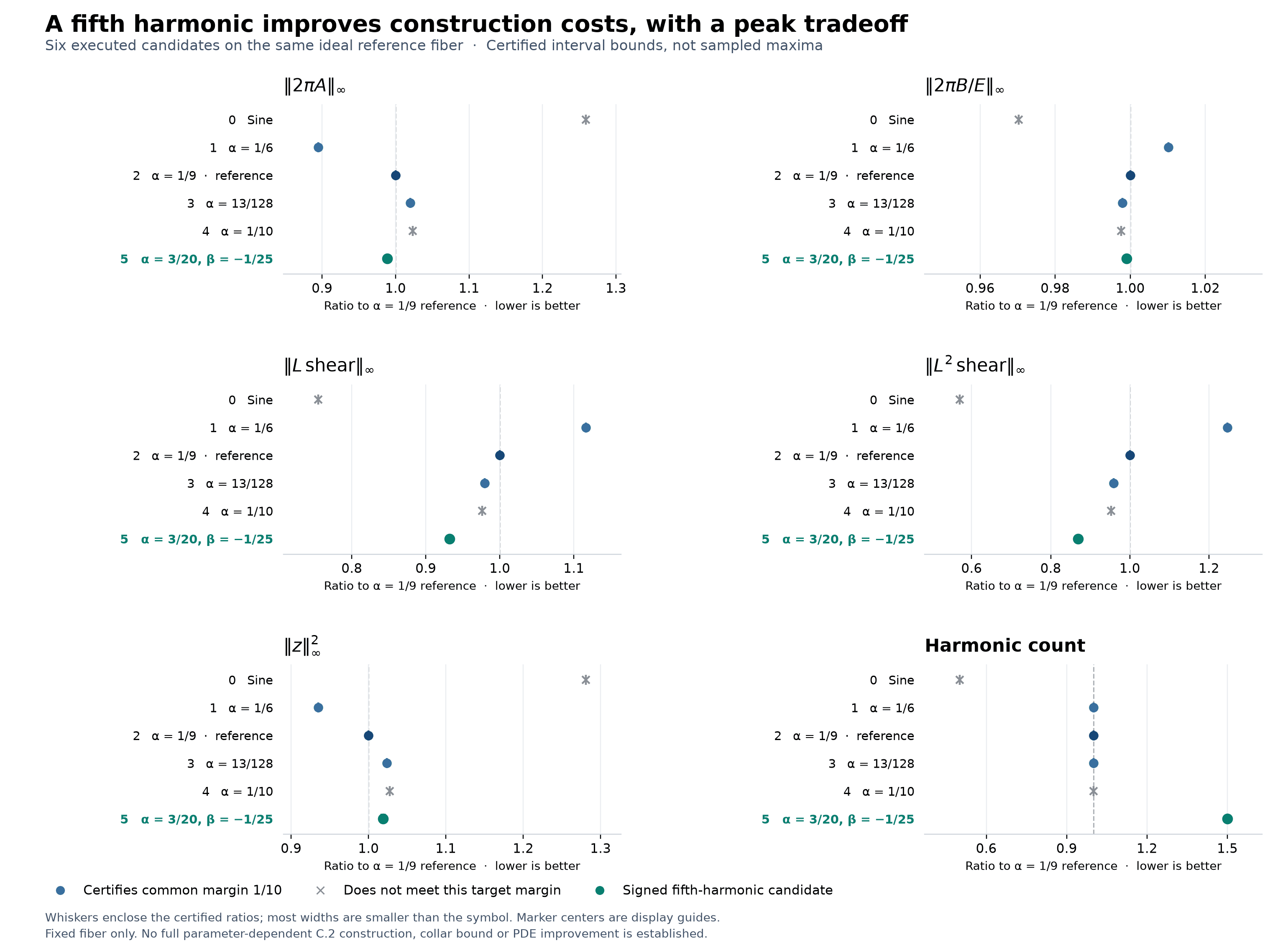
A proof that a fluid can blow up in finite time is, among other things, a piece of engineering. The September 2026 forced Navier-Stokes breakdown construction drives a self-similar vortex with oscillatory pulses, and each pulse is a loop that has to satisfy averaged conditions while keeping a safety margin against an inequality.1 Loops have shapes, shapes have costs, and costs feed the frequencies and forcing bounds the rest of the proof has to pay for. That makes a loop the kind of object a research database can hold, vary, certify and compare. So we did, twice, and both times the result moved.
First: a wider margin than any sine wave can give
We began by reproducing the published state: our NS Twin built the pinned source of the released development and checked both supplied Navier-Stokes comparison targets with the community's Comparator under two independent kernels.2 Then we went inside. At one ideal reference profile we reproduced the construction's sine loop and its average and inequality checks, and asked a sharper question: over the whole precisely declared family of single-sine loops, what is the best minimum margin available at all?
The answer is a number: about 0.0833620343077. It is a bound on the entire family, not a sampled maximum. Then we tried a shape outside the family, a sine with a third harmonic added, and certified a common margin of 0.1 at the same profile and mean-square condition. That is about 19.96 percent more margin than the best any one-sine loop can reach.3 The certificate is an interval enclosure over the whole phase, not a grid of samples, and an independent checker reconstructed the polynomials from the coefficients and confirmed it.
The cost the first result exposed
The wider margin was not free. The third-harmonic shape carries a larger derivative bound with respect to the auxiliary angle. In a database that stored only the winning number, that would be the end of the story. In the NS Twin the trade-off is a recorded observation on the same atom, and the open question it raised, whether the gain survives the coordinates the larger construction actually uses, became a typed plan in the research graph with the earlier result as its premise.
The next experiment the graph selected changed the harmonic ratio from one sixth to one ninth. It kept the margin at 0.1, lowered the auxiliary-angle derivative bound by 10.44 percent relative to the first harmonic shape, and raised the squared peak by 6.96 percent. Two shapes, two trades, both retained on a multi-objective frontier rather than collapsed into one winner, because which is better depends on constraints that live elsewhere in the proof.4
Second: lower costs in the construction's own coordinates
The construction does not measure loops by an auxiliary angle. It uses an inverse phase coordinate and two periodic primitives, and a shape that looks better in one coordinate can lose in another. That gave a discriminating hypothesis: can a waveform lower those actual costs while preserving the same reference averages and the same margin?
The Twin evaluated six precisely specified candidates using its native rigorous interval engine and a small bounded-degree polynomial extension, with whole-domain Bernstein enclosures rather than sampled maxima. An independent exact-rational checker rebuilt every polynomial from the candidate coefficients and confirmed the native enclosures. The useful candidate adds a signed fifth harmonic:
z(theta) = C [ sin(theta) + (3/20) sin(3 theta) − (1/25) sin(5 theta) ], with C² = 32500/10241.
At the fixed reference profile it keeps the common margin of 0.1 and improves all four targeted construction-cost coordinates relative to the one-ninth shape.
| Cost, same profile and normalisation | Certified change against the 1/9 reference |
|---|---|
| First inverse-phase shear derivative bound | About 6.79 percent lower |
| Second inverse-phase shear derivative bound | About 13.12 percent lower |
| Normalised periodic B-primitive supremum | About 0.10 percent lower |
| Periodic A-primitive supremum | At least 1.138 percent lower, from a proved upper against lower comparison |
| Squared peak amplitude | Higher, between 1.6 and 2.1 percent |
| Nonzero harmonics | Three instead of two |
The last two rows are the price. On the four construction-cost coordinates the fifth-harmonic shape removes the one-ninth shape from the attained frontier. Once peak and harmonic count are charged, the one-ninth shape is incomparable again and the frontier keeps it. The pure sine, which cannot certify the 0.1 margin at all, and a failed one-tenth control are kept as well, marked as what they are.5
Why this is a database result
Nothing above required a new theorem. It required a place where a formula, its exact rational parameters, its charted geometry, its certified bounds, the checks performed on it, the alternatives it beat and the alternatives it did not, and the next question it raised all share one identity and survive being closed and reopened. In the NS Twin the loop is a set of native mathematical expression atoms with typed links; the experiment plan that produced the fifth harmonic is bound to the plan identity that proposed it; the two measured completions are attached to the exact original plan records; and the whole store replays read-only in under thirty seconds with its corruption controls intact.6
Two smaller episodes show why that matters. A preflight formula for a primitive omitted a factor of one third when integrating the third harmonic. The independent checker caught it before qualification, the failed preflight is preserved as superseded, and the differentiation controls now reject a missing one-third or one-fifth divisor. A metadata error about where one candidate's peak occurs was caught and rerun the same way.7 A record that keeps its own mistakes with their corrections is a record a reviewer can trust.
What comes next, in order
The result is a fixed-profile, complete-phase certificate. The larger construction needs more, and the graph holds the sequence as typed plans, each prospective until its completion record is attached.
- Extend the fixed-profile choice over a compact admissible parameter patch with exact moments and a uniform margin, and certify the slow-parameter and mixed derivatives as well as the inverse-phase ones.
- Propagate the measured primitive and derivative bounds through the paper's actual frequency and collar estimates, and see whether a smaller required frequency or forcing bound follows. The fifth harmonic could lose once its extra complexity is charged there, and the frontier is built to record that.
- Only then attempt axis and collar gluing, with residual and non-degeneracy bounds and an explicit obstruction if the patch touches an inadmissible boundary.
What to bring us
- A construction author's eye. If you work on these constructions, the bounded loop and cost note is the thing to assess: is the improvement useful once the parameter-dependent estimates are charged?
- A rigorous-numerics reviewer. The certificates, the exact-rational checker and the corrupted-input controls are packaged for someone who wants them to fail.
- A component of your own proof. If a published construction has a piece with shapes and costs, the Twin can hold it, vary it and certify it the same way.
Write to hello@8braid.com with the subject "NS Twin: loop construction review". You will hear back from an engineer.
Sources and further reading
- OpenAI: the Navier-Stokes announcement and openai/NavierStokesAndEuler on GitHub
- leanprover/comparator
- Garloff, Convergent bounds for the range of multivariate polynomials, on Bernstein enclosures
- Moore, Kearfott and Cloud, Introduction to Interval Analysis, SIAM (2009)
- 8DB: The Week Navier-Stokes Moved, and What a Database Company Did About It
- 8DB: A Proof Is a Graph Where Confidence Only Flows Downhill
This is a local, fixed-profile construction result inside one component of a published proof. It does not establish a better full Navier-Stokes construction, global optimality over all loops, a frequency theorem, a new existence or blow-up theorem, or priority over the literature; third-harmonic shaping is itself an established idea, and novelty of the precise construction is unassessed. Every number is a certified interval bound or a certified ratio from the qualified result record dated 11 September 2026. 8Braid has no affiliation with OpenAI or any author of the construction.
Footnotes
-
The construction in question is the forced Navier-Stokes breakdown development released on 8 September 2026 and matched by the Comparator to the Formal Conjectures statement; the loops here are the ring-shaped oscillatory pulses at a single ideal reference profile. OpenAI's result concerns the supplied forced setting; nothing here bears on the unforced Clay alternatives. ↩
-
The NS Twin's Phase VI run built the pinned source and checked both Navier-Stokes comparison targets using the released Comparator with the nanoda kernel and Lean's default kernel. That reproduces the formal targets; it is distinct from producing an explicit numerical realisation of the entire singular construction, and it is not the first such reproduction, since our own earlier machine A events and at least five other parties had rebuilt or Comparator-checked the repository by 11 September. ↩
-
The one-sine family optimum of about 0.0833620343077 is an exact bound over the declared family; the third-harmonic margin of 0.1 is a certified common margin at the same reference profile and mean-square condition. The comparison is local to that profile. ↩
-
The one-ninth shape's auxiliary-angle derivative bound is still higher than the original same-speed sine bound; the improvement is relative to the one-sixth shape, not to the sine. ↩
-
Ratios are certified intervals from the qualified loop-cost result (SHA-256 28f87c54f9c7c995d46a35cfc3e93f76138bcdc6049ac8bcf0794ba442a50a44). The independent exact checker covered six candidates, 968 enclosures including 317 power and 544 Bernstein coefficient enclosures, 54 complete cells, and rejected all 37 deliberately corrupted inputs; earlier stage records cite 28 and 39 mutation controls for different audit stages, and the counts are not summed. The A-primitive comparison deliberately uses a proved upper and lower bound rather than a tighter sampled estimate. ↩
-
The native integration run passed with parsed GeoQL scheduling, six candidates, both frontiers, two completions bound to their original plan identities, a FileIo close and reopen, and four corruption and source controls; the final read-only replay took 28.18 seconds. GeoQL acts on candidate geometry as a scheduling observation; the interval certificates establish the numerical claims. The overlay compiled current production sources against a cached native core and is not a complete rebuild of every repository target. ↩
-
The frozen Phase VI certificates were unaffected by the preflight error. Both corrections were made before final qualification and the superseded records are retained. ↩
Continue the technical conversation
Where could this help your work?
Bring a research question, a database workload or an application you want to build. Let’s connect the ideas in this article to an evaluation that matters to your team.
Discuss this work