
8DB gives application builders native ways to work with relationships, location and time on a device, alongside protected storage and accountable delivery mechanisms. For a field team, that creates the opportunity to investigate locally, retain sensitive observations and confirm what reached the next authorized recipient.
Ditto and Couchbase Lite already provide substantial offline and peer-to-peer capabilities. Compare the complete application: what people can do while disconnected, how concurrent work is handled, and what the system can demonstrate afterward.
Start with the inspection
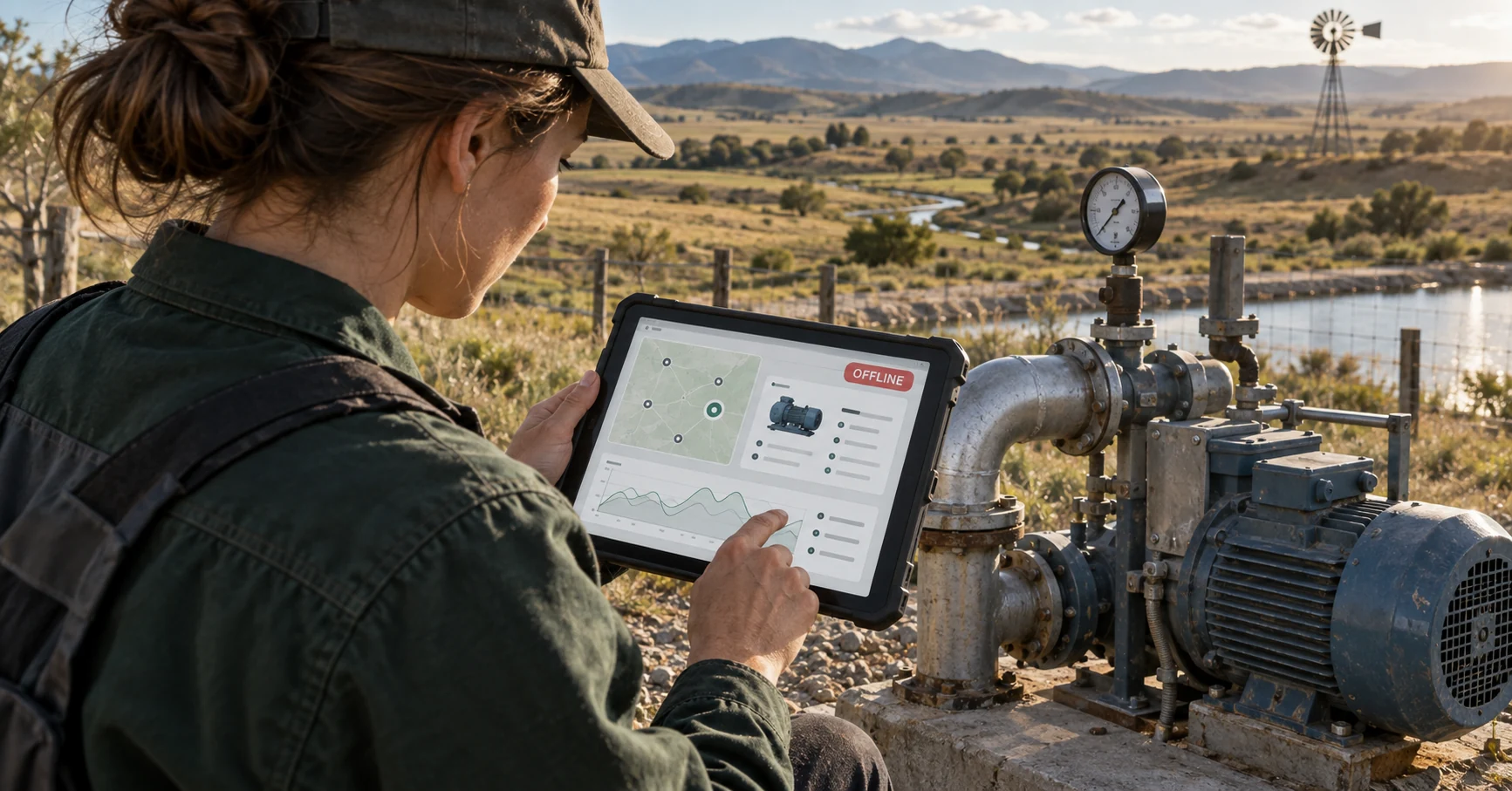
Imagine a technician inspecting equipment at a remote site. This is a hypothetical integration example.
The technician needs to find nearby assets, check their service history and compare a new reading with earlier observations. A colleague has recorded a different assessment of the same machine. Some information should remain on the team's devices; selected findings need to reach an authorized supervisor.
8DB's typed time series keep a measured value, a reading below a sensor's detection limit and a missing observation distinct. Interval-hull rollups retain bounds and coverage, helping the technician distinguish what the readings support from where more evidence is needed. Native time-series operations.
8DB's native operations make that a promising application to evaluate. Our article on the omnimodal difference explains how operations and connected representations can change the work an application performs. The inspection's selected objects and queries would still need qualification on its actual delivery route.
Give the existing mesh products their due
Ditto's native SDKs form a mesh using available transports including Bluetooth LE, LAN and platform-specific peer-to-peer Wi-Fi. Subscriptions select which data reaches a device, and its documented data types have merge rules for concurrent updates. Ditto mesh, data synchronization.
Couchbase Lite combines an embedded document database and SQL++ queries with replication. Its current Swift Multipeer route automatically discovers nearby peers. Wi-Fi discovery uses Bonjour; version 4.1 adds Bluetooth LE. When both transports are configured, it can switch between them. Replication filters and custom conflict resolution are available. Peer synchronization is an Enterprise feature. Multipeer documentation, edition boundary.
For a nearby team collaborating on documents, either deserves close attention. Check the target SDK and operating system: native mobile mesh support does not automatically apply to browsers or every desktop binding.
When the application needs richer local questions, recipient-controlled protection or a clearer delivery and recovery contract, those requirements can change which database is the better fit.
Follow the work beyond the connection.
A field inspection needs useful local answers, retained work and a trustworthy finish. Explore what to test at each stage.
Find an answer beside the equipment.
A technician needs the equipment’s site, connected assets and service history before starting work.
The app must answer
Can the device answer this useful query from the authorized data it holds?
The evidence to inspect
Run the query without a network. Check the answer, its source and how current the local data is.
Useful resultA usable local answer
Keep the observation with its context.
The technician records a fault, its location and the equipment it concerns while the link is unavailable.
The app must answer
What has the device promised to keep when it tells the technician the work is saved?
The evidence to inspect
Interrupt and reopen the app. Check the committed record and pending work under the stated failure model.
Useful resultSaved here; delivery pending
Send the right work to the right peer.
A connection returns. The app selects pending work, checks the destination’s current authority and handles retries.
The app must answer
Can the app reconcile retries and conflicting edits without losing their meaning?
The evidence to inspect
Break the link during delivery. Inspect identity checks, duplicate handling and the chosen conflict policy.
Useful resultConnected; completion still to confirm
Know what arrived, and what can recover.
The sender needs evidence of the receiver’s promised completion boundary, even if the reply was interrupted.
The app must answer
Does the receipt mean accepted, durably stored or applied, and can the app reconcile that state after failure?
The evidence to inspect
Match the receipt to the record. Restart the required endpoints and check recovered state against that promise.
Useful resultA completion claim backed by evidence
A working link does not establish a useful answer. A successful socket send does not establish the receiver’s promised completion.
Read all four stages
Consult locally
A technician needs the equipment’s site, connected assets and service history before starting work. Can the device answer this useful query from the authorized data it holds?
Check: Run the query without a network. Check the answer, its source and how current the local data is.
Capture disconnected
The technician records a fault, its location and the equipment it concerns while the link is unavailable. What has the device promised to keep when it tells the technician the work is saved?
Check: Interrupt and reopen the app. Check the committed record and pending work under the stated failure model.
Reconnect
A connection returns. The app selects pending work, checks the destination’s current authority and handles retries. Can the app reconcile retries and conflicting edits without losing their meaning?
Check: Break the link during delivery. Inspect identity checks, duplicate handling and the chosen conflict policy.
Confirm and recover
The sender needs evidence of the receiver’s promised completion boundary, even if the reply was interrupted. Does the receipt mean accepted, durably stored or applied, and can the app reconcile that state after failure?
Check: Match the receipt to the record. Restart the required endpoints and check recovered state against that promise.
Decide what “delivered” means
The supervisor needs to know which inspection arrived and whether its records remain usable. A connection indicator answers an earlier question.
8DB's protected delivery path supplies a durable encrypted queue, retry handling, signed receipts bound to accepted content and reconciliation at the source. In a completed vendor-run Linux rehearsal, it captured 16,384 records while disconnected, then delivered them with 128 new records. A separate verifier reconciled all 16,512 records, their content and receipts; a fresh process reopened the stores and confirmed no pending deliveries. The rehearsal used local TCP endpoints and test keys. Published rehearsal and scope.
Physical power loss, the customer's radio network and the proposed inspection workflow need their own tests. The linked report distinguishes this completed rehearsal from a larger unfinished delivery campaign.
Ditto also exposes local commit and per-peer progress tracking. Couchbase's Multipeer API reports peer and document replication events. Compare what each signal confirms, then connect it to the action your user cares about. The distinction among saved locally, accepted remotely and ready for the supervisor should be visible in the application.
Keep protection and collaboration explicit
For sensitive inspections, ask who can open the content along its route. 8DB's reviewed protected-node architecture creates recipient-bound messages independently of where an outer TLS connection terminates. An intermediary can carry ciphertext without payload keys; the authorized recipient opens the message and protects its local records. How the security architecture works.
The integrated Required node profile currently uses fixed peers and admits canonical lexical records. It is an ordered replication path, with majority-based progress, rather than a general offline multiwriter system. The completed telemetry rehearsal uses a separate delivery workflow. In the reviewed Apple candidate, the local-evaluation profile disables mesh. These are distinct starting points for an evaluation, not one already-shipped inspection application.
The technician's disagreement also needs a deliberate rule. Keeping both observations may be appropriate; resolving a shared status may require another policy. Ditto's merge semantics and Couchbase's custom conflict resolution are concrete alternatives to assess. Whatever the engine, test the meaning of the result as well as whether replicas converge.
Permission changes deserve the same attention. A disconnected device can enforce the authority it holds, but cannot learn a remote revocation before that update reaches it. Define which work can continue and which actions must wait.
Choose the application you want to operate
Compare one useful job on the devices, networks and protection settings you expect to use. Include discovery, local questions, conflicting edits, interruption, delivery confirmation and recovery. Count retained copies, memory, battery use and operator effort alongside latency. A cross-vendor speed ranking requires that matched work; the evidence here makes no such ranking.
Bring one non-sensitive data journey: the field question, devices, expected outage and result the next person must receive. We can map a supported starting point and test how much useful work, protection and delivery 8DB brings together for your application.
Continue the technical conversation
Where could this help your work?
Bring a research question, a database workload or an application you want to build. Let’s connect the ideas in this article to an evaluation that matters to your team.
Discuss this work